
Future Frames: NZ Hybrid AI Short Film Competition and Workshops (New Zealand, 23 May - 3 July 2026)
By Alfio Leotta and Paul Wolffram
This year marks the third edition of FutureFrames:NZ, a nationwide short film competition and workshop series that aims to position Aotearoa New Zealand at the forefront of debates around AI and creative practice. Conceived as an experimental platform for collaboration between human filmmakers and generative AI tools, the initiative encourages teams of two to five participants to produce original short films (1–5 minutes) that integrate AI within traditional filmmaking workflows. Rather than endorsing a techno-determinist vision in which AI replaces human creativity, FutureFrames:NZ foregrounds the role of human agency, emphasising ethical engagement, creative control, and the responsible management of emerging technologies.
The project is led by Co-Founders Producer Melissa Conway and Composer Graeme Revell, and it is supported by the Screen Music & Sound Guild of New Zealand (SMSG), with funding from the New Zealand Film Commission (NZFC) and NZ On Air, the country's main screen media public funding agencies. Additional institutional backing is provided by SAE Creative Media Institute, APRA AMCOS and Screen Auckland. A key component of the initiative this year, was its workshop series, designed to contextualise AI within contemporary screen practice. Six industry-led sessions were delivered online on 23 May 2026, bringing together practitioners from across writing, editing, sound, music, producing and directing. These workshops were mainly framed as critical forums addressing the broader implications of AI for authorship, ethics, labour, and creative identity.
The opening session, led by screenwriter and entertainment executive Steve Barr, focused on scriptwriting and “story sovereignty” in the age of AI. Barr highlighted a crucial legal and creative issue: AI-generated scripts and content are not covered by copyright, raising significant questions about authorship, ownership, and the sustainability of creative labour. Subsequent sessions explored domain-specific applications of AI, revealing both its affordances and limitations.
Sound professionals Polly McKinnon and Matt Stutter addressed the use of AI in dialogue replacement (ADR) and audio enhancement workflows. While acknowledging certain efficiencies, they concluded that generative AI currently performs poorly in complex sound design tasks, underscoring the continued necessity of specialist human expertise. Similarly, composer Jeff Wragg examined AI-driven music tools, noting their utility in generating placeholders or creative prompts, but emphasising that the collaborative relationship between filmmaker and composer grounded in iterative dialogue remains irreplaceable.
From a production perspective, technology entrepreneur Greg Harman introduced Scriptsee, an AI-powered pre-production analytics platform developed in New Zealand. The tool analyses screenplays to generate visual insights into narrative structure, character dynamics, and production complexity. Harman’s presentation demonstrated how AI can function as a decision-support system, augmenting rather than displacing the role of producers by enabling more informed and efficient planning processes.
Post-production practices were addressed by editor Jason Stutter, who presented hybrid workflows combining traditional editing techniques with AI-enabled tools already embedded within industry-standard software. His session illustrated how AI is becoming increasingly integrated into existing infrastructures, facilitating efficiencies while simultaneously expanding creative possibilities. The final workshop, led by director and creative technologist Arthur Machado, synthesised these discussions by examining directing in a hybrid AI environment. Through case studies of AI-generated commercials, Machado demonstrated how filmmakers can integrate machine-generated elements while maintaining authorial coherence and stylistic consistency.
Across the series, a recurring theme was the necessity of maintaining human-centred approaches to AI. Contributors consistently framed AI as an assistive technology, capable of accelerating processes, generating ideas, and supporting decision-making, yet ultimately dependent on human judgement, creativity, and ethical responsibility. This perspective aligns with the broader pedagogical aim of FutureFrames:NZ, to equip filmmakers with the skills and critical awareness needed to navigate an increasingly complex technological landscape.
The workshops concluded with a Q&A session focused on the competition, reinforcing the initiative’s dual role as both a professional development opportunity and a creative challenge. 25 teams, which included a mix of emerging and established media professionals, entered the competition, with participants required to submit their completed films by 21 June 2026. In late June, the FutureFrames:NZ organisers announced the 10 finalist teams, who were judged by a panel of industry professionals to select the top 3 films. All 10 finalist teams were invited to attend the award ceremony and received travel grants to support their participation.
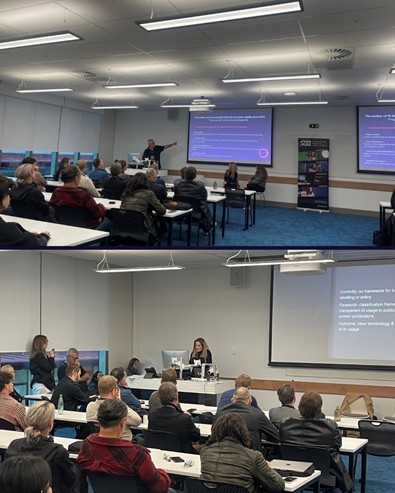
The award ceremony was preceded by a panel discussion titled AI in Evidence. Filmmaker-researcher Caroline Bell-Booth (DEGANZ) shared early findings from her Master's research on classifying AI use in New Zealand screen production, exploring how greater transparency could help funding bodies, policymakers, practitioners, and audiences make informed decisions about AI in publicly funded screen projects. She was joined by FutureFrames:NZ co-founder and composer Graeme Revell, who reflected on the opportunities and challenges AI presents for creative practice. Revell highlighted the four pillars that distinguish FutureFrames:NZ: Education (free GenAI workshops), Hybrid Creativity (AI as one tool among many), Ethical Practice, and Industry Pathways (mentoring and support for international festival submissions).
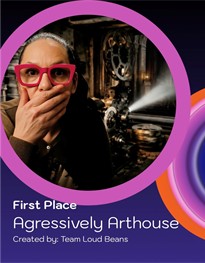
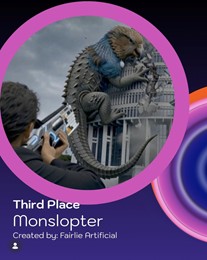
The event concluded with the awards ceremony which was attended by the ten finalist teams and a large audience of Big Screen Symposium delegates. Third place was awarded to Fairlie Artificial for Monslopter, an action-comedy about two agents attempting to stop a gigantic AI-generated slop monster. Second place went to Butter Production for Happy Feet, Big Feelings, a Pixar-style parody of Happy Feet. The overall winners were Loud Beans for Aggressively Arthouse, a poetic exploration of diverse film aesthetics that effectively showcased the versatility of generative AI.

In addition to the cash prize, Loud Beans will receive comprehensive sound and music post-production support, as well as assistance with entering international AI film competitions. These opportunities will help extend the project’s reach and impact beyond the national context.
FutureFrames:NZ can be understood as a significant intervention in the evolving relationship between AI and screen media. By combining creative production with critical discourse, the initiative creates a space in which filmmakers can experiment with new tools while reflecting on their implications. In doing so, it challenges reductive narratives of technological replacement and instead promotes a model of “hybrid creativity” grounded in collaboration, reflexivity, and ethical engagement. For screen practitioners in Aotearoa New Zealand and beyond, the project offers a compelling framework for thinking about how human creators can shape, rather than be shaped by, the future of AI-driven filmmaking.
This report was proofread with the assistance of Microsoft Copilot.