
Published 23-11-2025
Copyright (c) 2025 Olly Gruner, Louis Netter

This work is licensed under a Creative Commons Attribution 4.0 International License.
Abstract
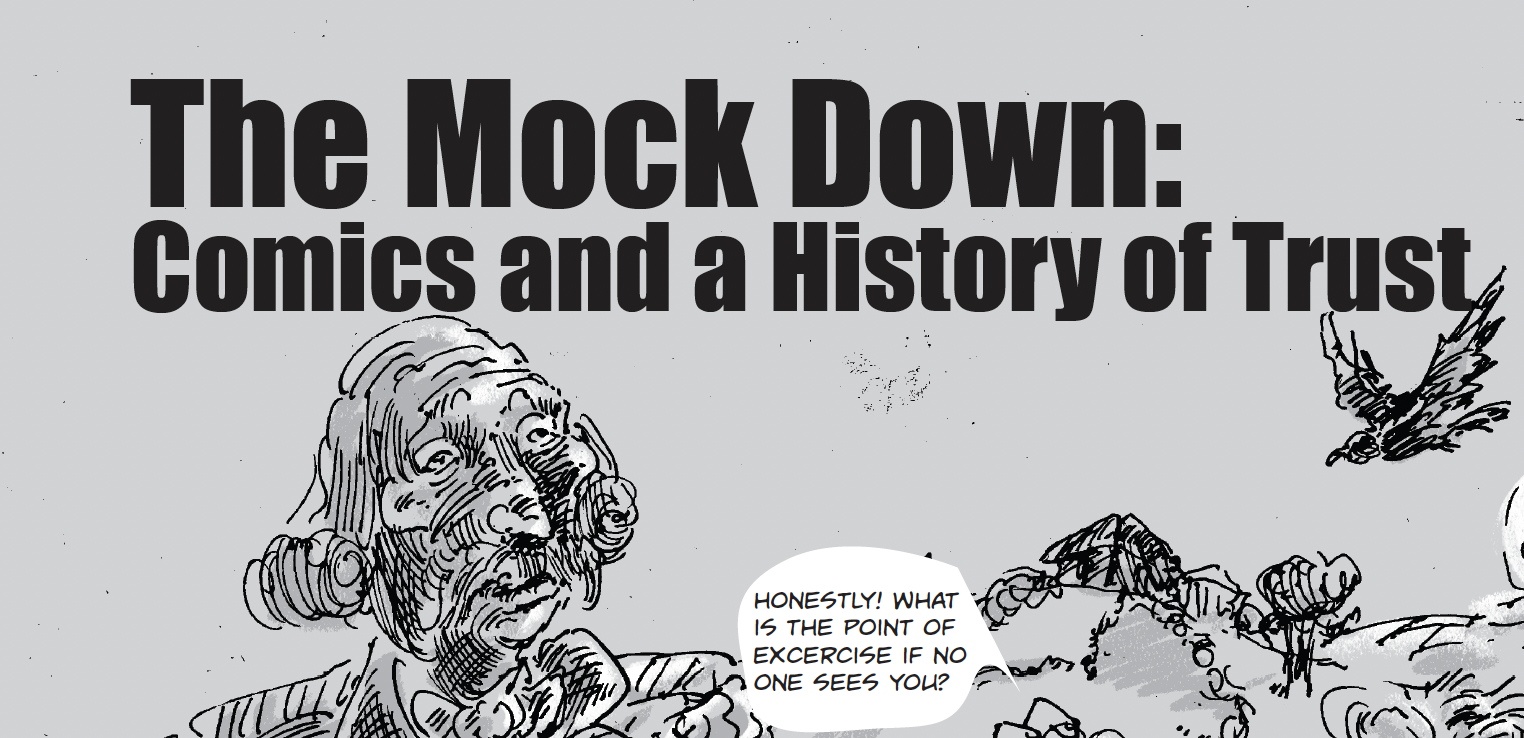
Taking as a starting point recent political and cultural debates surrounding the Covid-19 pandemic (2020-), this graphic research paper explores questions of “trust” as they have appeared in a variety of historical contexts. The concept of trust is a familiar one to psychologists, behavioural economists and political scientists, who have considered its implications within a variety of individual, group and national settings, including in relation to the pandemic. However, as the historian Geoffrey Hosking (2014) has observed (and his points seem to us to remain valid today), there are fewer explicit histories of trust, or efforts to explore the ways in which configurations of trust ebb, flow and/or break across specific historical periods. Rather than attempt any singular expansive history, we are concerned, here, with making a case for the value of practice research and, especially, comics-based research, as a useful method through which to interrogate trust and the various ideas and conflicts that it potentially evokes. As a medium that many scholars argue is especially given to metacommentary – on its own status as a constructed/invented representation, on its “factual” limitations, on the omissions lurking beyond its panels – the comic offers an array of formal and stylistic devices pertinent to those seeking to analyse trust and attendant issues of truth, fabrication, conspiracy and lies. Our article experiments with such devices, suggesting ways in which they allow for the development of visual symmetries, politically charged metaphors and historical connections that offer fresh perspective on, or “a different way of looking” at, this timely phenomenon. Engaging with philosophical writings on the nature of history, our article also contributes to wider debates on the value of creative practice as a form of historical and historiographical research. We provide at the end of the comic extensive explanatory notes and an introduction to our approach, but invite readers to engage with the images and text in ways that allows them to uncover their own interpretations, connections and meanings.