
Published 26-10-2026
Copyright (c) 2026 Dr, Jonah

This work is licensed under a Creative Commons Attribution 4.0 International License.
Abstract
This article proposes that Virtual Production (VP) constitutes a significant inflection point in the longer trajectory of Tangible User Interface (TUI) research. Revisiting Hiroshi Ishii’s foundational concept of “tangible bits,” we argue that VP re-situates embodied expertise within digital space, extending TUI’s critique of WIMP-style graphical interfaces into contemporary production and beyond.
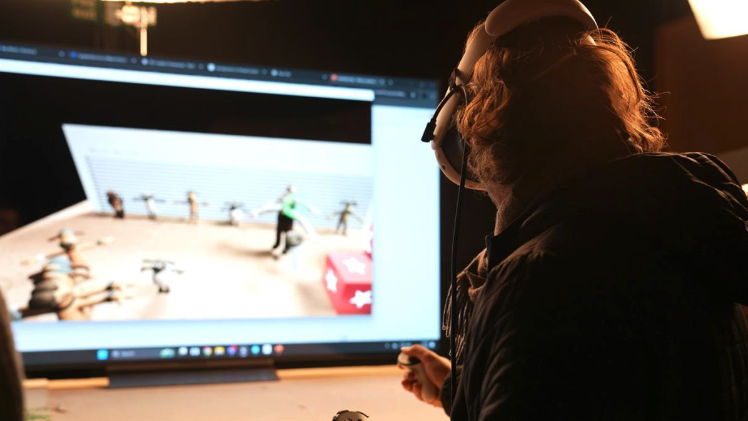
The argument is developed through a case study of the UKRI-funded Virtual Production at Model Scale (VPaMS) project at Aardman Animations. Through iterative prototyping two experimental tools—the Puppet Sculpt Tool and the Block Out Tool—were designed to integrate mixed-reality affordances into stop-frame animation workflows. These tools demonstrate how spatial interfaces can recontextualize embodied craft knowledge without displacing the material practices central to Aardman’s animation ethos. We take this hybrid physical-digital workflow as a platform to think about how virtual production and TUI assemblages might arise beyond film-making contexts.
Moving beyond the case study, the article adopts a dialogic format to explore broader implications of VP’s convergence with TUI. It examines how advances in real-time rendering, VR/AR hardware, and game engine infrastructures are reshaping expectations around spatial interfaces, and considers how VP practices prefigure emerging paradigms of “spatial computing.” We introduce the concept of “the virtual production of everyday life” to describe the potential diffusion of VP-style embodied computational interfaces into domestic and professional contexts. This diffusion carries a dual promise: lowering barriers to sophisticated computation through spatially intuitive interfaces, while simultaneously risking the normalization of embodied interaction according to technical defaults.
Ultimately, the article situates VP within a longer history of human–computer relations, arguing that it might lie in its capacity to reimagine how physical expertise, craft, and phenomenological experience can be integrated into increasingly pervasive computational infrastructure.