
Editorial, Volume 14: Extending Virtual Production: Beyond the Volume
Published 26-10-2026
Copyright (c) 2026 Gregory Bennett, Chen Chen, Dafydd Sills-jones

This work is licensed under a Creative Commons Attribution 4.0 International License.
Abstract
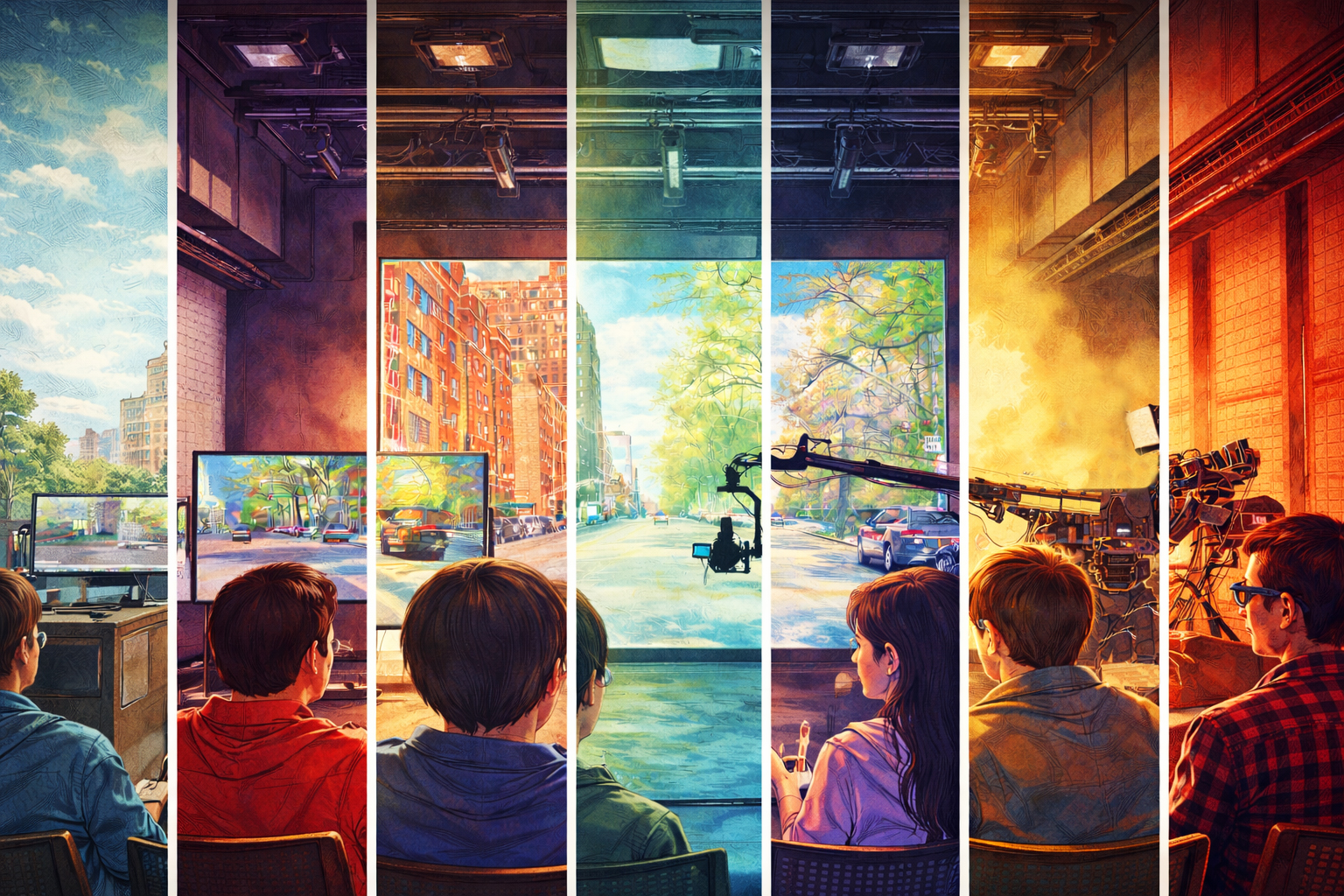
Virtual production (VP) brings together technologies and working methods from film, television, visual effects, computer games and immersive media. The term is often associated with LED volumes, where performers work in front of real-time digital environments, but it covers a wider range of production practices. These include virtual cameras, motion capture, real-time rendering, camera tracking, previsualisation and the use of digital environments in live-action and entirely virtual productions.
This special issue of the International Journal of Creative Media Research, Extending Virtual Production, looks at how these technologies and methods are being used across different areas of creative practice.
The contributions range from screen production and animation to theatre, dance, education and culturally situated approaches to digital media. Others explore computational methods for generating images and reconstructing environments. Taken together, they offer a view of a field whose development is taking place in commercial production, university studios and smaller experimental projects.
The intention is not to present a single account of what virtual production is, or what it might become. The articles address different aspects of the field, from particular technologies and production methods to questions of collaboration, performance, cultural knowledge and teaching. They also reflect the different circumstances in which VP is practised, and the practical considerations that shape its use.
The articles collected in Extending Virtual Production demonstrate the range of practices now associated with VP. Alongside work in film and television, the issue considers applications in performance, education, cultural practice and experimental digital production. The contributions do not offer a single model for the field; instead, they show how its technologies and methods are being adapted to different creative purposes and working conditions.
We hope the issue will be of interest to researchers, educators and practitioners, and will contribute to ongoing discussion about the uses and development of virtual production. We would like to thank all the authors for their contributions and the reviewers for the time and care they have given to the process.